

How Long to Bloom Coffee: 30 to 60 Seconds Explained
Last Updated: November 1, 2026
Quick Summary
Bloom coffee for about 30 to 60 seconds after the first splash of hot water. This short pause lets trapped carbon dioxide escape so water can soak the grounds evenly. Fresher, lighter roasts usually need the longer end of the range.
- Pour about twice the coffee weight in water for the bloom, such as 40 grams for 20 grams of coffee.
- Use a 45 to 60 second bloom for coffee roasted only a few days ago.
- Use a 20 to 30 second bloom for coffee more than two weeks past roast.
- Swirl the dripper gently instead of stirring aggressively with a spoon.
- Test one variable at a time, brewing at 30, 45 and 60 seconds, to find your sweet spot.
Table of Contents
- What Coffee Blooming Is and Why It Matters
- How Long to Bloom Coffee: The 30 to 60 Second Range
- How Much Water for Coffee Bloom and the Right Ratio
- Step-by-Step Pour-Over Blooming Technique
- Should You Stir or Swirl the Bloom?
- Troubleshooting Weak, Uneven, or Overflowing Blooms
- Run a Bloom Time Test With Your Next Bag
- Frequently Asked Questions
What Coffee Blooming Is and Why It Matters
Blooming is the short pause you give freshly ground coffee after the first splash of hot water. The grounds swell and release a burst of gas, mostly carbon dioxide, that was trapped during roasting. Done well, it sets up even extraction for the rest of the brew.
Here is why it matters. Carbon dioxide sitting inside the bean repels water. If you pour straight through, that trapped gas pushes water unevenly through the coffee bed. Some grounds get extracted too much, others too little, and the cup tastes flat, sour or harsh at once. A bloom lets that gas escape first, so the water can soak every particle more evenly.
Many brewers treat the bloom as a formality, but it is also an early point of control over flavor after grinding.
How Long to Bloom Coffee: The 30 to 60 Second Range
For most pour-over brews, a bloom of about 30 to 60 seconds is the practical starting point. The exact number matters less than watching what the grounds do.
A simple rule works well:
- Under 30 seconds: The gas may not fully escape. Expect a muted or uneven extraction.
- 30 to 45 seconds: A solid default for most roasts and most people.
- 45 to 60 seconds: Useful for very fresh coffee that still bubbles strongly.
- Over 60 seconds: Rarely needed. The grounds have usually finished outgassing.
Treat these numbers as a starting range, not a fixed law. Your grinder, your dripper and your water temperature all shift the result.
A Practical Decision Guide by Roast Age, Roast Level, and Brew Method
Most advice stops at a time range. A better approach is to choose a starting bloom time based on three variables: how long ago the coffee was roasted, how dark the roast is, and which brewer you are using. Use the chart below as a starting point, then adjust by taste.
| Roast age | Roast level | Brew method | Suggested bloom | Why |
|---|---|---|---|---|
| 1-5 days | Light to medium | Pour-over | 45-60 seconds | Lots of trapped CO2; a longer pause lets gas escape so water can soak evenly. |
| 1-5 days | Dark | Pour-over | 30-45 seconds | Dark roasts degas faster and can foam heavily; a shorter bloom avoids overflow. |
| 6-14 days | Light to medium | Pour-over | 30-45 seconds | Gas release has slowed but is still active. |
| 6-14 days | Dark | Pour-over | 30 seconds | Most gas is gone; a short bloom is enough to wet the bed. |
| 15+ days | Any | Pour-over | 20-30 seconds | Little gas remains; focus on even saturation rather than waiting for bubbles. |
| Any | Any | Batch brewer | 30-45 seconds | A short pause before the main cycle helps saturate the bed evenly. |
| Any | Any | Immersion (French press, Clever) | 30 seconds | Stir gently once, then let the crust settle before the main steep. |
This chart is a starting point, not a rule. If your coffee is very fresh and bubbles vigorously, lean toward the longer end. If it is older or dark-roasted, lean shorter. The goal is to wet every ground evenly and let excess gas escape without turning the bloom into a long wait.
How Degassing and Roast Age Change Bloom Time
Degassing is the slow release of carbon dioxide after roasting. Freshly roasted beans release a lot of gas in the first few days (Carbon monoxide emission rates from roasted whole bean and ground coffee). As the days pass, that release slows. This is why bloom behavior changes with roast age.
Very fresh coffee, roasted only a few days ago, usually needs a longer bloom and bubbles vigorously. Coffee that is a few weeks old may need only a short bloom, because most of the gas is already gone. Lighter roasts tend to hold more gas and bloom more visibly than darker roasts.
If you want to know how long roasted coffee stays fresh, that affects bloom timing directly. Check the roast date on the bag and adjust your bloom to match.
How Much Water for Coffee Bloom and the Right Ratio
A common approach is to use about two times the coffee weight in water for the bloom. For example, 20 grams of ground coffee takes about 40 grams of water. That is enough to soak the grounds fully without flooding the bed.
Use this ratio as your starting point:
- Coffee: 15 to 20 grams
- Bloom water: 30 to 40 grams, about 2:1 water to coffee
- Total brew water: Follow your recipe, often around 1:15 to 1:17 overall
Too little bloom water leaves dry pockets. Too much can let the grounds float and wash out early. Pour just enough to wet every grain.
Step-by-Step Pour-Over Blooming Technique
Here is a clean method you can repeat at home:
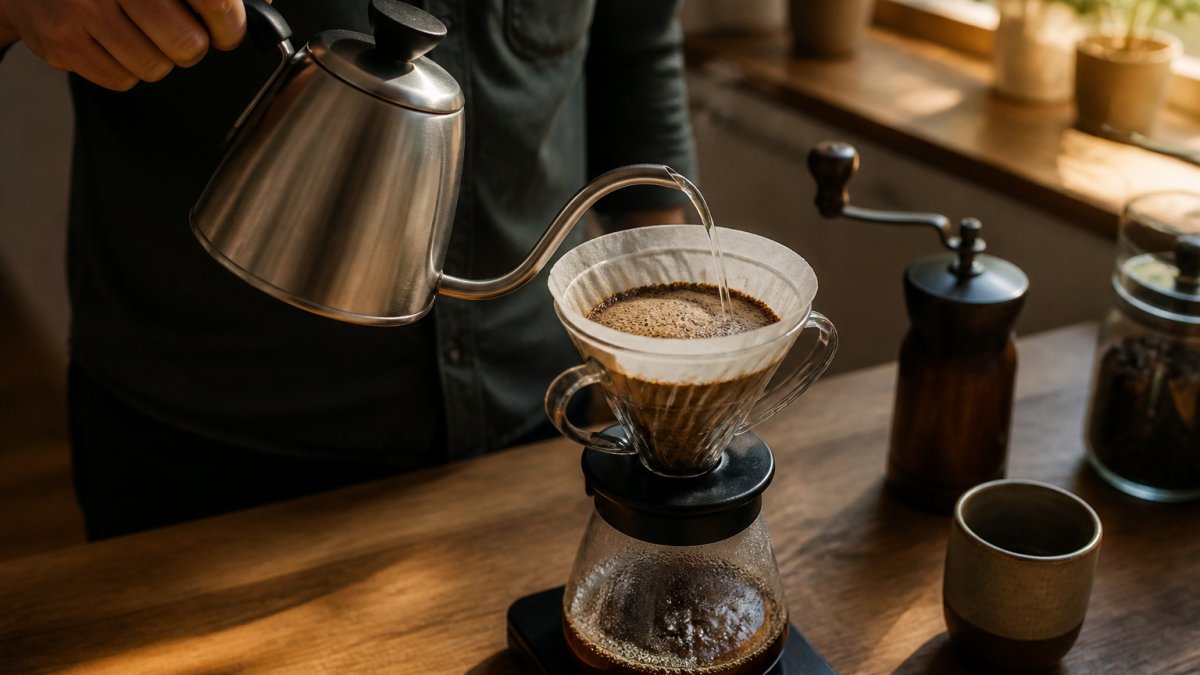
- Heat water to roughly 200 to 205°F, a common range for medium roasts.
- Place your filter in the dripper, rinse it, and discard the rinse water.
- Add your ground coffee and level the bed gently.
- Start your timer and pour the bloom water in a slow, steady spiral, wetting all the grounds.
- Wait 30 to 45 seconds. Watch for the bed to rise and bubble.
- Begin your main pours in slow circles, keeping the water level steady.
- Finish the brew and taste. Adjust bloom time on your next cup if needed.
Pouring technique matters. Pour gently from a moderate height. A hard, fast pour pushes grounds around and disturbs the bloom.
The Ethiopia Natural single origin, with milk chocolate and fruity notes, is a good coffee to practice this on.

Should You Stir or Swirl the Bloom?
Many brewers ask whether they should stir the bloom. A gentle swirl of the dripper is usually enough. Stirring with a spoon can break the bed unevenly and bring fines to the top, which may cause bitterness.
Swirl gently, or tap the side of the dripper once, to level the surface and help the grounds release gas. Then let the bloom rest. Avoid aggressive stirring unless your specific recipe calls for it.
Troubleshooting Weak, Uneven, or Overflowing Blooms
Blooms do not always behave. Here is what to check when results look off:
- Weak or no bubbling: Your coffee may be old, so the gas is largely gone. Try a shorter bloom, or buy a fresher bag.
- Uneven bubbling: Dry pockets in the bed. Pour bloom water more evenly across the whole surface.
- Overflowing or foaming excessively: Very fresh coffee or too much bloom water. Reduce the bloom amount or lengthen the pause slightly.
- Flat or sour taste after bloom: Under-extraction, often from a bloom that was too short for fresh coffee.
- Bitter or harsh taste: Over-extraction or aggressive stirring. Keep the bloom gentle and check your grind size.
Water temperature and consistency also affect results. Keep your kettle temperature steady, and pour at a consistent speed each time so you can compare cups fairly.
What Bubbling Patterns Actually Tell You
Bubbles are a useful signal, but they are not a precise freshness test. What matters is the pattern and how it changes over time.
- Vigorous, even bubbling across the whole bed: The coffee is releasing a lot of gas, usually because it is fresh. A longer bloom (45-60 seconds) can help, but watch for overflow.
- Bubbling only in patches: Water is not reaching every ground evenly. Pour more slowly and in a tighter spiral, or give the dripper a gentle swirl to level the bed.
- A few large bubbles that pop slowly: Normal for coffee that is a week or two old. A 30-45 second bloom is usually enough.
- Almost no bubbling: The coffee has largely finished degassing. This is not a defect; it just means you can shorten the bloom to 20-30 seconds and focus on even saturation.
- Foam that rises quickly and threatens to overflow: Very fresh coffee or too much bloom water. Reduce the bloom water to about 1.5-2 times the coffee weight and pour more gently.
A common mistake is to read bubbles as a scorecard for freshness. They are better used as a guide for how much gas is still present and how evenly the bed is wetting. If the bed looks dry in spots, fix the pour before changing the bloom time.
Adjusting Without Overcorrecting
When a bloom goes wrong, change one variable at a time. If the bed is uneven, adjust pouring technique first. If the bloom overflows, reduce water volume before shortening the time. If the cup tastes flat, try a slightly longer bloom on the next brew, but keep grind size and water temperature the same so you can tell what actually changed.
Run a Bloom Time Test With Your Next Bag
The best way to find your ideal bloom time is to test it. Use one bag of coffee and change only one variable at a time. Brew three cups at 30 seconds, 45 seconds and 60 seconds, keeping everything else the same.
Taste each cup and note what changes. Look for sweetness, balance, clarity and any bitterness or sourness. Write down your findings so you can repeat the best result.
Testing works well with an origin that has clear flavor markers. The Colombia and Costa Rica single origins both have distinct profiles that make differences easy to notice.


Once you find your sweet spot, you will know exactly how long to bloom coffee for your own kettle, grinder and taste. That small pause, done with care, is one of the easiest ways to turn an ordinary morning cup into something worth savoring.
Frequently Asked Questions
How long should you let coffee bloom?
Most pour-over brewers let coffee bloom for about 30 to 45 seconds, and many extend it to 45 to 60 seconds with fresher, more recently roasted beans. The goal is to let carbon dioxide escape until bubbling slows and the grounds look evenly wet. Beans roasted only a few days ago release more gas and may need the longer end of the range, while beans roasted weeks earlier may need less. Use the bloom time as a starting point, then adjust after tasting a few cups.
How much water should you use for the coffee bloom?
A common approach is to use roughly two times the weight of the coffee for the bloom. For example, 20 grams of ground coffee takes about 40 grams of water. This saturates the grounds enough to trigger degassing without soaking the whole bed. The full brew then continues with your usual water-to-coffee ratio, such as 1:15 or 1:16. Weigh your water with a scale for consistent results from one brew to the next.
Should you stir or swirl coffee during the bloom?
A gentle swirl of the dripper or a light stir with a spoon helps wet all the grounds evenly, which supports even extraction. Avoid aggressive stirring, because it can break the coffee bed and cause channeling. Once the grounds are evenly saturated, stop agitating and let the bloom finish undisturbed. Some brewers skip agitation entirely if their pouring technique already wets the bed uniformly.
What happens if you bloom coffee for too long?
Blooming for much longer than about 60 seconds can cause the grounds to lose aromatic compounds and flatten the cup, especially with coffee that is already a few weeks past roast. Extended blooms can also reduce the time you have for the main pour and lead to a slower drawdown. If your cup tastes dull or flat, shorten the bloom in small steps and taste again. Track each change so you can see what improves the flavor.
