

Why Volcanic Soil Makes Better Tasting Coffee
Table of Contents
- What Volcanic Soil Is and How It Forms
- How Soil Affects Coffee Taste
- Mineral and Nutrient Content That Shapes Flavor
- Best Soil for Coffee Plants: Why Volcanic Loam Wins
- Coffee Terroir Explained: Soil, Elevation, and Climate
- Coffee Processing and Flavor: Beyond the Soil
- Volcanic Coffee Worth Trying: Real Examples
- Frequently Asked Questions
Last Updated: October 14, 2026
What Volcanic Soil Is and How It Forms
Volcanic soil forms from weathered lava, ash, and tephra. These mineral-rich materials break down into fertile loam that retains nutrients while draining well, making volcanic regions ideal for coffee plants that develop complex flavor profiles.
Formation takes decades or centuries: lava cools and fractures, then weathers through rain, temperature shifts, and microbial activity, while ash adds fine particles rich in potassium, magnesium, and phosphorus. The result is soil with exceptional mineral content and fertility that supports slow plant growth.
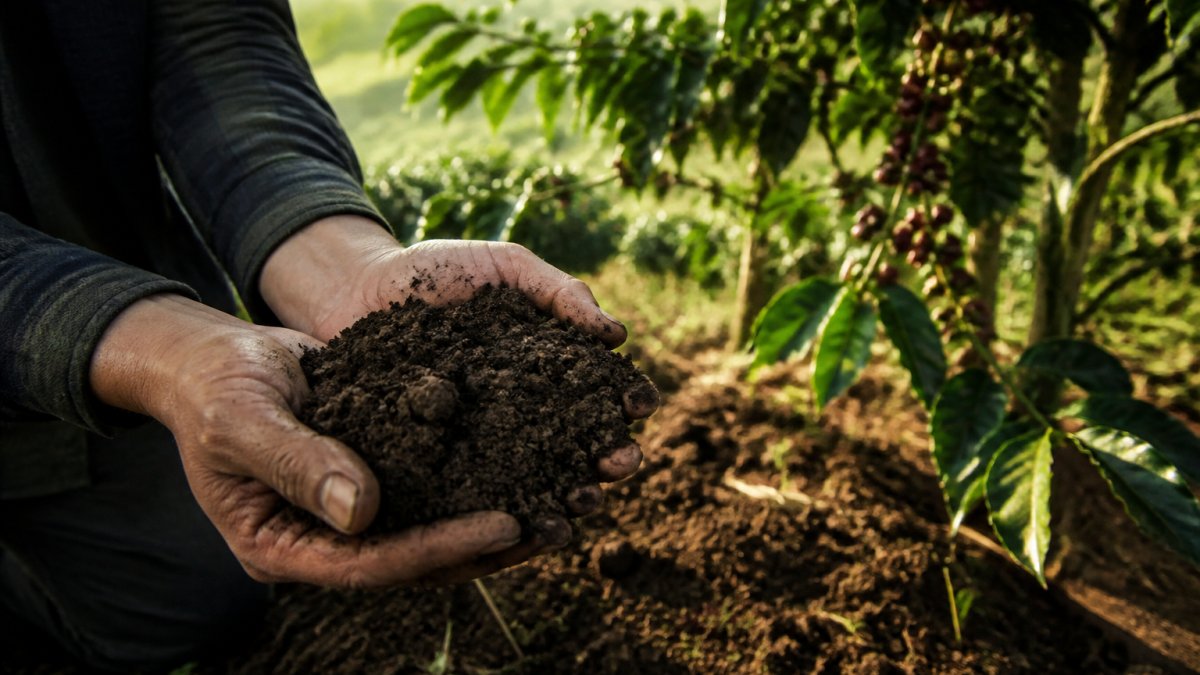
Volcanic soil's defining traits are mineral density and porosity. The porous structure drains quickly, preventing root rot while holding moisture for dry periods, so coffee plants develop deeper roots that extract more nutrients.
How Soil Affects Coffee Taste
Soil doesn't just feed the plant; it shapes the chemical compounds that develop inside the coffee cherry. Coffee grown in mineral-rich volcanic soil absorbs nutrients that later express themselves as distinct tasting notes.
Coffee plants pull minerals from the soil and concentrate them in the cherry, contributing to sweetness, acidity, and body. A coffee grown in volcanic soil versus non-volcanic soil tastes noticeably different, even when processed and roasted identically.
Soil pH, drainage, and nutrient availability all influence cherry development. Volcanic soils tend toward the slightly acidic pH coffee prefers, which affects nutrient metabolism and sugar accumulation, translating to more balanced flavors after roasting.
Mineral and Nutrient Content That Shapes Flavor
Volcanic soils are often called "mineral-rich," a phrase that does quiet work in coffee marketing. Unpacking what the minerals actually do separates a useful origin story from a misleading one.
What volcanic soils actually contain. Soils from volcanic parent material tend to be high in potassium, magnesium, calcium, phosphorus, and trace elements like iron, manganese, and zinc.
The part most articles get wrong. It is tempting to say potassium "becomes sweetness" or magnesium "becomes" a flavor compound. It doesn't work that way.
Why this distinction matters. If minerals transferred directly into flavor, every coffee on the same volcanic ridge would taste identical. They don't: two farms a kilometer apart can produce very different cups because of cultivar, elevation, shade, harvest timing, processing, and roast.
Nutrient availability, not just content. A soil can be rich in a mineral yet a poor source of it if the mineral is locked in forms plants cannot absorb.
USDA Natural Resources Conservation Service soil survey information
Best Soil for Coffee Plants: Why Volcanic Loam Wins
Across coffee-growing regions worldwide, volcanic loam, a mix of volcanic minerals, clay, and organic matter, is the preferred soil for specialty coffee. It balances water retention with drainage, provides consistent nutrients, and supports healthy root development.
Volcanic loam's structure makes it superior: not too dense (waterlogging) and not too sandy (fast drainage). Coffee plants develop strong roots with reliable moisture and nutrient access all season, supporting the even cherry ripening essential to flavor quality.
Coffee grown in volcanic loam also develops slower, concentrating sugars and flavor compounds in the cherry. The plant invests energy into cherry development rather than rapid vegetative growth, yielding denser beans with more complex chemistry.
At Canvas and Clove LLC, we source from regions where volcanic loam dominates the soil profile. Our Guatemala offering, grown in Antigua at 1200-1616 meters altitude, develops in volcanic loam that produces those distinctive dark chocolate and bright fruit notes. Similarly, our Bali Blue from Kintamani grows in volcanic loam at 1200-1600 meters, yielding the molasses and brown sugar characteristics that define the cup.

Coffee Terroir Explained: Soil, Elevation, and Climate
Terroir is the full environmental package shaping coffee flavor: soil, elevation, temperature, rainfall, and microclimate. Volcanic soil is one component, working in concert with the rest.
Elevation amplifies volcanic soil's effect. Cooler temperatures slow cherry ripening, letting sugars accumulate more fully, while the soil supplies mineral density. The combination creates beans with exceptional sweetness and complexity.
Climate interacts with soil to influence water availability and nutrient cycling. Consistent rainfall supports continuous nutrient uptake; seasonal dry periods can concentrate flavors. Volcanic soil's drainage matters most in high-rainfall regions, preventing waterlogging while holding moisture for dry spells.
The best coffee terroirs combine volcanic soil with elevation between 1200-1700 meters, consistent but not excessive rainfall, and temperature ranges that favor slow cherry development. Our Costa Rica offering, sourced from Alajuela micro farms at 1300-1445 meters in volcanic loam, exemplifies this balance. The result is that distinctive sweet apple, raisin, and honey profile.

Coffee Processing and Flavor: Beyond the Soil
Most volcanic-soil articles skip this: even if soil shapes a coffee's raw potential, the cup you drink is decided by choices made after the cherry is picked. Here is how to test whether volcanic soil is doing anything in your cup.
The chain of variables between soil and cup. At least six post-harvest factors can shape flavor as much as or more than soil:
- Cultivar. Bourbon, Typica, Caturra, Pacamara, Gesha, and SL28 have genetically different flavor tendencies. A Gesha grown on volcanic soil and a Gesha grown on non-volcanic soil will share more with each other than either will with a Bourbon from the same farm.
- Elevation and temperature. Cooler nights slow cherry development and concentrate sugars and acids. This is often the single largest driver of perceived quality in specialty coffee.
- Shade and canopy. Shade slows ripening and can change how sugars and acids accumulate.
- Harvest selectivity. Picking only ripe cherries versus strip-picking whole branches changes the sugar and acid profile of the lot dramatically.
- Processing. Washed, natural, honey, wet-hulled, and anaerobic methods produce very different cups from the same cherries. Washed processing tends to highlight clarity and acidity; natural processing tends to add fruit and fermentation notes; wet-hulled processing (common in Indonesia) tends to add earthy, savory, and sometimes cedar-like notes.
- Roast and brew. Roast level determines how much origin character survives. Brew ratio, grind, water chemistry, and temperature determine how much of that character reaches your palate.
Soil sits underneath all of these. It can influence how the plant performs, but it does not override cultivar, elevation, processing, or roast.
A practical framework for evaluating a volcanic-soil claim. If a roaster credits volcanic soil for a coffee's taste, test it honestly:
- Look for traceability. A specific farm, a specific lot, a harvest year, and ideally a processing method. "Volcanic soil" alone is a marketing phrase; "Finca X, Lot 14, washed, 1,650 m, 2025 harvest" is a claim you can actually evaluate.
- Read the tasting notes against the processing. If the coffee is a natural or anaerobic lot, much of the fruit and fermentation character is coming from processing, not soil. If it is a washed lot with clean acidity and a mineral-adjacent finish, soil and elevation are more plausible contributors.
- Compare like with like. The only fair test is two coffees of the same cultivar, similar elevation, similar processing, and similar roast, one from volcanic soil, one from non-volcanic soil. That comparison is rare, which is exactly why strong claims about soil are hard to verify.
- Taste side by side, blind if possible. Cup them at the same dose, grind, water, and temperature. Note acidity, sweetness, body, and finish separately. If the volcanic-soil coffee is consistently brighter or more structured across multiple brews, that is a signal. If the difference disappears when you change the roast or the brew, it probably was not the soil.
- Repeat across origins. One coffee is an anecdote. Three or four volcanic-origin coffees from different regions, tasted against non-volcanic comparisons, start to become a pattern.
What to expect, and what not to. Experienced tasters often find high-elevation volcanic-origin coffees show bright, structured acidity, medium-to-full body, and a clean, sometimes mineral-adjacent finish. But that pattern also fits high elevation, washed processing, and careful roasting, all common in volcanic regions for reasons unrelated to soil chemistry.
A note on sustainability and trade-offs. Farming volcanic slopes carries risk: highly erodible soils on steep terrain, plus landslide, ashfall, and eruption hazards alongside soil depletion and rising input costs. Buying volcanic-origin coffee often supports farms managing genuinely difficult terrain.
Specialty Coffee Association cupping protocol and standards
Volcanic Coffee Worth Trying: Real Examples
To taste how volcanic soil influences coffee flavor, start with single-origin coffees from established volcanic regions, which give the clearest expression of soil's role.
Our Guatemala from Antigua grows in volcanic loam at 1200-1616 meters. Its dark chocolate, bright fruit, and butterscotch profile reflects both the soil's mineral content and slower cherry ripening at elevation.
Our Bali Blue from Kintamani, Indonesia, grows in volcanic loam at 1200-1600 meters. Its dark chocolate, molasses, and brown sugar notes reflect volcanic soil in a tropical climate, while wet-hulled processing adds earthy complexity.

Our Costa Rica from Alajuela grows in volcanic loam at 1300-1445 meters. Its sweet apple, raisin, and honey profile shows how volcanic soil at moderate elevation produces bright, fruit-forward coffee, with eco-pulped processing preserving those delicate notes.
Each of these coffees costs $23.99 and represents a different expression of why volcanic soil makes better tasting coffee. Try them side by side to understand how soil, elevation, processing, and roasting work together.
The relationship between volcanic soil and coffee flavor is real, but not magic.
Frequently Asked Questions
Does volcanic soil actually make coffee taste better?
Volcanic soil creates conditions that can enhance coffee flavor, but soil is one factor among many. Volcanic loam provides excellent drainage, mineral availability, and slow nutrient release that encourages robust root development and slower cherry ripening. This extended growth period allows coffee beans to develop greater sugar complexity and denser cell structure. However, the final flavor also depends on elevation, climate, cultivar, processing method, roasting, and brewing technique. Volcanic soil alone doesn't guarantee superior taste, but it provides a strong foundation for quality.
What minerals in volcanic soil help coffee plants?
Volcanic soil contains potassium, magnesium, iron, manganese, and silica, all essential for coffee plant health. Potassium supports fruit development and sugar accumulation in the coffee cherry. Magnesium is central to chlorophyll production, enabling photosynthesis that fuels bean growth. Iron and manganese support enzyme function and nutrient metabolism. These minerals weather slowly from volcanic ash and rock, providing steady nutrient availability throughout the growing season rather than quick nutrient spikes that can stress the plant. This sustained feeding promotes balanced plant health and more complex flavor development in the beans.
How does volcanic soil affect coffee flavor?
Volcanic soil influences flavor through three pathways: mineral uptake, drainage, and growth rate. Superior drainage prevents root disease and waterlogging while maintaining consistent moisture, allowing the plant to invest energy in cherry ripening rather than survival.
Is coffee grown in volcanic soil more expensive?
Volcanic soil itself doesn't determine price, elevation, processing method, cultivar, and brand positioning do. Many volcanic coffee origins, like those from Guatemala and Bali, command premium prices ($23.99 per bag at Canvas and Clove) because they combine volcanic soil with high elevation, careful cultivation, and meticulous processing. However, volcanic soil is common in major coffee regions worldwide, so price reflects the complete terroir and production quality, not soil type alone. You can find both affordable and expensive volcanic coffees depending on the origin and roaster.