

7 Ways to Brew Loose Leaf Oolong Tea
Table of Contents
- Understanding Oolong Tea: Oxidation and Roast Level
- Essential Equipment and Water Quality for Brewing Oolong
- Oolong Tea Water Temperature and Steeping Time Fundamentals
- Method 1: Gongfu Style Oolong Tea Brewing
- Method 2: Western-Style Brewing in a Teapot
- Method 3: Cold Brew Oolong Tea
- Method 4: Grandpa Style (Large-Pitcher Brewing)
- Method 5: Mug Infuser Brewing
- Brewing Oolong Tea: A Quick Reference
- Common Brewing Mistakes and How to Fix Them
- Frequently Asked Questions
Last Updated: October 10, 2026
Understanding Oolong Tea: Oxidation and Roast Level
To brew loose leaf oolong tea properly, you need to understand that oolong sits between green and black tea on the oxidation spectrum, with partially oxidized leaves that create complex flavor.
Light oxidation (20-40%) produces floral, grassy notes; medium (40-60%) brings fruity, honey-like flavors; heavy (60-80%) creates deeper profiles. Roasting level matters equally, lightly roasted oolong brews differently than heavily roasted.
Heavily oxidized and roasted oolong leaves handle hotter water and longer steeping times; lightly oxidized leaves need gentler treatment.
Essential Equipment and Water Quality for Brewing Oolong
You don't need expensive gear to brew good oolong.
Essential equipment:
- A kettle (electric or stovetop)
- A brewing vessel (teapot, gaiwan, mug infuser, or pitcher)
- A thermometer (optional but helpful)
Equipment alternatives for accessibility:
A ceramic bowl or coffee mug replaces a gaiwan.
Water quality and how it affects flavor:
Water quality affects flavor significantly.
Mineral content (hardness):
Water hardness (measured in ppm of dissolved minerals) ideally ranges 50-150 ppm for oolong.
Chlorine and off-flavors:
Chlorine masks oolong's delicate notes.
pH and mineral balance:
Neutral to slightly alkaline water (pH 6.5-7.5) is ideal; most tap water qualifies.
Practical water choices:
- Tap water: Use if it tastes clean with no strong chlorine smell.
- Filtered tap water: Removes chlorine and excess minerals; replace filters every 2-3 months.
- Bottled spring water: Check label for 50-150 ppm mineral content.
Fresh water matters:
Never reuse water boiled multiple times, each boil removes dissolved oxygen and flattens flavor.
Oolong Tea Water Temperature and Steeping Time Fundamentals
Water temperature is the most critical variable when you brew loose leaf oolong tea. Too hot creates bitterness; too cool tastes weak.
Temperature guidelines:
- Lightly oxidized oolong: 160-180°F (70-80°C)
- Medium oxidized oolong: 180-200°F (80-93°C)
- Heavily oxidized or roasted oolong: 195-212°F (90-100°C)
A thermometer removes guesswork, or let boiling water cool 3-5 minutes before pouring.
Steeping time depends on method: 30-60 seconds in a gaiwan, 3-5 minutes in a Western teapot.
You can re-steep oolong leaves multiple times, with each infusion tasting different.
Method 1: Gongfu Style Oolong Tea Brewing
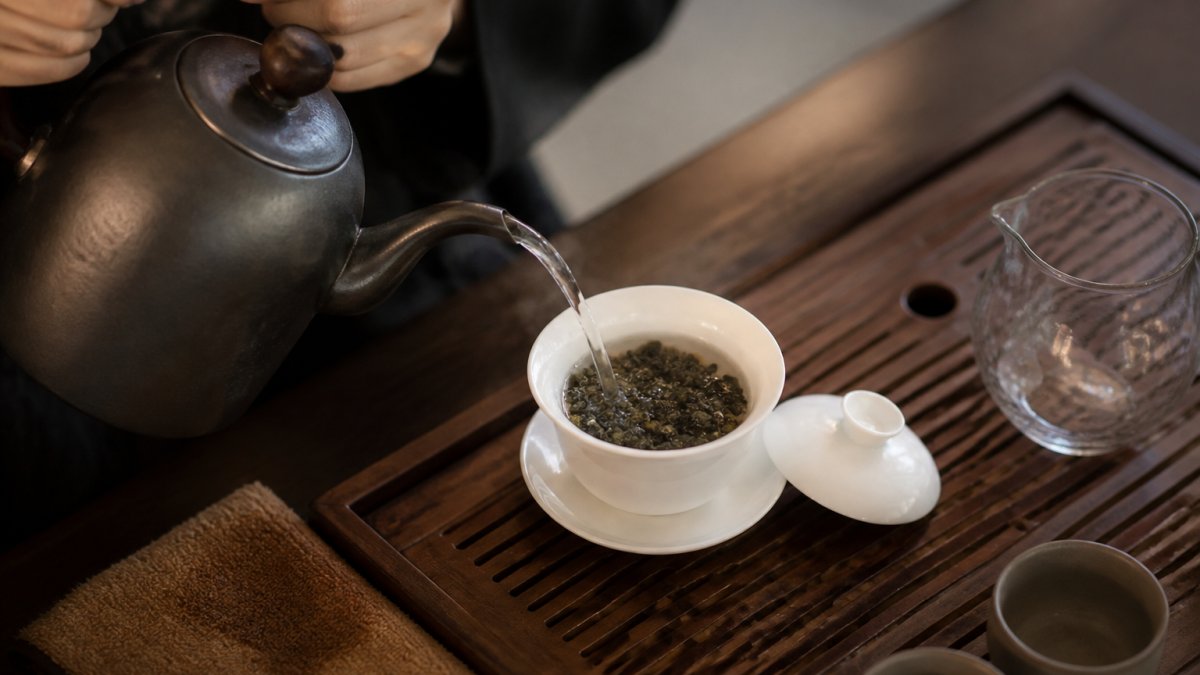
Gongfu brewing is the traditional method from China. It uses small vessels, short steeping times, and multiple infusions. This method highlights the tea's complexity and aroma.
What you'll need:
- A gaiwan (small lidded bowl) or small teapot (3-6 ounces)
- A brewing tray or large saucer (to catch drips)
- Fresh, filtered water
Steps:
-
Warm your vessel. Pour hot water into the gaiwan and swirl it around. Discard the water. This keeps your tea hot during brewing.
-
Add tea leaves. Use about 1 teaspoon (or 3-5 grams) of loose leaf oolong per 2-3 ounces of water. Gongfu brewing uses more leaves than Western brewing.
-
Rinse the leaves. Pour hot water over the leaves, let sit 5-10 seconds, then discard. This wakes up the leaves and removes dust, improving flavor.
-
First infusion. Heat fresh water to the right temperature for your tea (see temperature guidelines above). Pour water over the leaves until full. Cover and steep for 30-60 seconds.
-
Pour and enjoy. Pour all tea into a cup to prevent over-steeping.
-
Re-steep. Add fresh hot water and steep 30-60 seconds. Re-steep 3-5 times; each infusion tastes different.
Pros: Highlights complex flavors, uses less water, multiple infusions, meditative ritual.
Cons: Requires attention and timing, needs special equipment, takes longer.
Method 2: Western-Style Brewing in a Teapot
Western-style brewing is simpler and more forgiving. You use more water, longer steeping times, and fewer infusions, ideal for a full cup without fussing.
What you'll need:
- A teapot (8-16 ounces)
- A strainer or infuser basket
- Fresh, filtered water
Steps:
-
Warm the teapot. Pour hot water into the pot and swirl it around. Discard the water.
-
Add tea leaves. Use 1 teaspoon of loose leaf oolong per 8 ounces of water. This is less leaf than gongfu brewing.
-
Pour hot water. Use water at the temperature that matches your tea's oxidation level (see fundamentals section above).
-
Steep for 3-5 minutes. Western brewing uses longer steeping times than gongfu. Start at 3 minutes. If your tea tastes weak, steep longer next time.
-
Pour into cups. Remove the infuser or strain the leaves before serving.
-
Optional second infusion. You can re-steep the same leaves once or twice, but they'll taste weaker than the first cup.
Pros: Simple, produces full cup, requires less equipment, forgiving timing.
Cons: Long steeping times risk bitterness, fewer infusions, less nuanced flavor than gongfu.
Method 3: Cold Brew Oolong Tea
Cold brew is the easiest method: combine tea and water, then wait. No heating required; the result is smooth and naturally sweet.
What you'll need:
- A pitcher or jar
- Fresh, filtered water (cold or room temperature)
- Loose leaf oolong tea
Steps:
-
Add tea to the pitcher. Use 1 teaspoon of loose leaf oolong per 8 ounces of water.
-
Pour in cold water. Fill the pitcher with cold or room temperature filtered water.
-
Refrigerate. Cover the pitcher and place it in the refrigerator.
-
Wait 6-12 hours. The longer you wait, the stronger the flavor. Most cold brews are ready in 8 hours.
-
Strain and serve. Pour through a fine strainer into a glass. Serve over ice if desired.
Pros: No heating or equipment, smooth and sweet, great for warm days, batch-friendly.
Cons: Takes 6-12 hours, less aromatic, less complex flavor.
Method 4: Grandpa Style (Large-Pitcher Brewing)
Grandpa style is the most casual method: brew tea directly in a mug or pitcher and sip as you go. Popular in China and Taiwan for everyday drinking.
What you'll need:
- A large mug or pitcher (12-16 ounces)
- Fresh, filtered water
- Loose leaf oolong tea
Steps:
-
Add tea to the mug. Use 1-2 teaspoons of loose leaf oolong.
-
Pour hot water. Fill the mug with hot water at the right temperature for your tea.
-
Let the leaves settle. Wait 1-2 minutes for the leaves to sink to the bottom.
-
Sip and refill. Drink from the mug, leaving the leaves at the bottom. When the cup is half empty, refill with hot water.
-
Continue all day. You can refill the same leaves 5-10 times throughout the day.
Pros: No equipment or timing, continuous brewing, leaves unfold gradually, relaxed process.
Cons: Leaves can over-steep, less flavor control, weakens with refills.
Method 5: Mug Infuser Brewing
A mug infuser holds tea leaves while you brew in your cup, convenient for single servings with minimal cleanup.
What you'll need:
- A mug infuser (a small basket or mesh ball that fits inside a mug)
- A mug or cup
- Fresh, filtered water
Steps:
-
Fill the infuser. Add 1-2 teaspoons of loose leaf oolong to the infuser basket.
-
Place the infuser in your mug. Set the infuser inside an empty mug.
-
Pour hot water. Fill the mug with water at the right temperature for your tea.
-
Steep for 3-5 minutes. Start with 3 minutes. Adjust based on taste.
-
Remove the infuser. Lift out the infuser when the tea reaches your desired strength.
-
Optional re-steep. You can re-steep the same leaves by adding fresh hot water to the infuser and steeping again.
Pros: Simple, portable, easy cleanup, affordable.
Cons: Limited leaf space, harder to control timing, fewer infusions.
Brewing Oolong Tea: A Quick Reference
| Method | Steep Time | Water Temp | Infusions | Best For |
|---|---|---|---|---|
| Gongfu | 30-60 seconds | 160-212°F | 3-5 | Flavor complexity |
| Western | 3-5 minutes | 160-212°F | 1-2 | Full cup, simplicity |
| Cold Brew | 6-12 hours | Cold water | 1 | Smooth, sweet taste |
| Grandpa Style | 1-2 min initial, refill as you go | 160-212°F | 5-10 | All-day brewing |
| Mug Infuser | 3-5 minutes | 160-212°F | 1-2 | Single serving |
Common Brewing Mistakes and How to Fix Them
Problem 1: Bitter or astringent tea
Cause: Water too hot, steeped too long, or too many leaves.
Fix by oxidation level:
- Lightly oxidized oolong (20-40%): Reduce water temperature to 160-170°F. These delicate leaves burn easily. If you're using a thermometer, aim for the lower end of the range.
- Medium oxidized oolong (40-60%): Reduce steep time by 15-30 seconds. Start at 2 minutes in Western brewing or 20 seconds in gongfu, then increase gradually.
- Heavily oxidized or roasted oolong (60-80%): Reduce leaf quantity. Use 0.75 teaspoons instead of 1 teaspoon per 8 ounces. These leaves are robust; you may be over-extracting.
Problem 2: Weak or flat tea
Cause: Water too cool, steeped too short, or too few leaves.
Fix by oxidation level:
- Lightly oxidized oolong: Increase water temperature to 175-180°F. These leaves need gentler heat but still need enough to unfold fully.
- Medium oxidized oolong: Add 15-30 seconds to steep time. Start at 3.5 minutes in Western brewing or 40 seconds in gongfu.
- Heavily oxidized or roasted oolong: Increase leaf quantity to 1.5 teaspoons per 8 ounces. These leaves are tightly rolled and need more mass to create body.
Problem 3: Inconsistent results between brews
Cause: Varying water temperature, leaf quantity, or steep time.
Fix: Use a thermometer and write down what works.
Problem 4: Leaves not opening or unfolding
Cause: Water temperature too low or leaves not rinsed.
Fix: Rinse leaves first (5-10 seconds, then discard).
Problem 5: Tea tastes cloudy or muted
Cause: Hard water or old leaves.
Fix: Use filtered water if you see mineral buildup.
Problem 6: Leaves over-steeping in grandpa style or mug infuser
Cause: Leaves left sitting in water too long.
Fix: Remove infuser or pour out liquid after each sip.
A repeatable adjustment framework:
- Identify the problem: bitter, weak, or inconsistent?
- Check your tea's oxidation level (listed on package). Lightly oxidized is floral; medium is fruity; heavily oxidized is deep.
- Adjust one variable: temperature, steep time, or leaf quantity. Brew a test batch.
- Write down what worked and repeat it.
- In gongfu or grandpa style, if second infusions taste worse, you're over-extracting; reduce steep time.
Frequently Asked Questions
What temperature should water be for brewing oolong tea?
Most oolong teas brew best between 195-212°F (90-100°C). Lighter, less-oxidized oolongs prefer the lower end of this range (195-205°F), while heavily roasted varieties benefit from near-boiling water. Use a thermometer to dial in the exact temperature, or let just-boiled water cool for 30 seconds to 2 minutes before pouring. Water that is too hot can scald delicate leaves and create harsh, bitter flavors; too-cool water may under-extract the tea's full aroma and complexity.
How long should you steep loose leaf oolong tea?
Initial steeping time ranges from 3-5 minutes depending on the brewing method and oolong style. Gongfu brewing uses shorter infusions of 20-45 seconds per steep, allowing multiple infusions. Western-style brewing in a teapot typically requires 4-5 minutes for the first infusion. Cold brew oolong tea steeps for 6-12 hours in the refrigerator. Start at the lower end of the range and adjust upward if the brew tastes weak; reduce time if it becomes too astringent or bitter. Leaf expansion and oxidation level also affect steeping time.
Can you cold brew loose leaf oolong tea?
Yes, cold brew oolong tea is an excellent method that highlights the tea's natural sweetness and reduces bitterness. Place loose-leaf oolong in a pitcher or infuser with cold water at a ratio of 1 teaspoon per 8 ounces of water, then refrigerate for 6-12 hours. The longer steeping time extracts flavor slowly without heat, creating a smooth, naturally sweet brew. Cold brew is ideal for oolong styles that are lightly oxidized or floral; it also works well for larger-pitcher brewing if you prefer a gentler approach to flavor extraction.
How much loose leaf oolong tea should I use per cup?
Use approximately 1 teaspoon of loose-leaf oolong per 8 ounces of water as a starting point. For gongfu brewing, increase the ratio slightly to 1 teaspoon per 6 ounces to account for shorter steeping times and multiple infusions. For a stronger brew, add an extra half-teaspoon; for a lighter cup, reduce by half a teaspoon. Rolled leaves expand significantly during steeping, so they take up more space than their dry volume suggests. Adjust based on personal preference and the specific oolong variety you are using.
Brewing loose leaf oolong tea is a skill that improves with practice. The right water temperature, steeping time, and brewing vessel unlock the tea's full potential. Canvas and Clove LLC's carefully sourced oolong selection is designed to shine with any of these methods. Start with whichever approach fits your lifestyle, and adjust your technique based on how the tea tastes. The goal is simple: a cup that brings you calm and joy.