

How to Make Coffee Taste Less Acidic Without Milk
Last Updated: October 30, 2026
Quick Summary
To make coffee taste less acidic without milk, first fix under-extraction: grind one notch finer, extend brew time slightly, and use water near the lower end of 195 to 205 degrees Fahrenheit. Change only one variable at a time and taste between each change. If the cup turns bitter, back off one step, since how to make coffee taste less acidic without milk depends on finding the balance point for your beans.
- Sourness usually comes from under-extraction, when water pulls too little of the sweeter compounds from the grounds.
- Grind one notch finer or extend brew time, changing only one variable per cup.
- Aim for roughly 195 to 205 degrees Fahrenheit, and try the lower end if the coffee tastes sharp.
- Choose medium or medium-dark roasts and natural or honey processing for rounder, less sharp cups.
- Keep dose and water weight steady, starting near a 1:16 ratio, so your comparisons stay fair.
Table of Contents
- Why Your Coffee Tastes Sour in the First Place
- What You'll Need Before You Start Adjusting
- Step 1: Adjust Your Grind Size and Brew Time
- Step 2: Lower Your Water Temperature and Control Extraction
- Step 3: Pick the Right Low-Acid Coffee Brewing Methods
- Step 4: Choose Beans by Roast, Origin and Processing
- Does Salt or Baking Soda Actually Help, and What to Watch For
- Your Next Brew: Running a Simple A/B Taste Test
- Frequently Asked Questions
Coffee that tastes sour or sharp is one of the most common complaints home brewers have, and most of the time you can learn how to make coffee taste less acidic without milk by adjusting how you brew rather than reaching for sugar. Many people assume sourness simply means the beans are too acidic, but the cause is often how the coffee was extracted. The good news is that small changes to grind, water temperature and brew time can make a noticeable difference in a single session.
Why Your Coffee Tastes Sour in the First Place
Sourness in coffee usually comes from under-extraction, meaning the water did not pull enough of the sweeter, rounder compounds out of the grounds. Acidic compounds dissolve quickly, so they show up first. A brew that is too short, too cool or too coarse often tastes sharp and thin for this reason. Understanding this helps you fix the problem at the source rather than masking it.
Sourness Versus Actual Acidity: A Quick Diagnostic
Sourness and acidity are related but not the same. Acidity is a natural, often pleasant brightness in the bean. Sourness is an unbalanced sharpness caused by how you brewed. To tell them apart, brew one cup a little longer or a little finer than usual. If the sharpness fades and the cup tastes rounder, the issue was extraction. If it stays just as bright, the bean itself is likely highly acidic, and you will need to choose a different coffee.
What You'll Need Before You Start Adjusting
Gather a few basics before you change anything, so you can track what works:
- A burr grinder that can grind coarse to fine
- A kitchen scale and a timer
- A kettle that lets you control or read the water temperature
- Your usual brewer, such as a French press, drip machine or pour-over
- A notebook or phone note for logging each change
Changing one variable at a time makes the results easier to trust.
Step 1: Adjust Your Grind Size and Brew Time
Grind size and brew time are the two fastest levers you have, but the fix depends on your brewer. Instead of changing both at once, run a controlled sequence: change one variable, taste, then decide. The table below gives a starting point for the three most common home brewers. Treat these as first adjustments, not fixed rules, your grinder, water and beans will shift the sweet spot.
| Brewer | If the cup tastes sour, try | Typical starting grind | Typical brew time | One-variable test |
|---|---|---|---|---|
| Drip machine | One notch finer; add 15-30 seconds of contact time if your machine allows | Medium | 4-6 minutes total cycle | Grind one notch finer only; keep dose and water the same |
| French press | One notch finer; extend steep by 30 seconds | Coarse | 4 minutes | Extend steep to 4:30 before changing grind |
| Pour-over | One notch finer; slow the pour slightly | Medium-fine | 2:30-3:30 | Tighten grind one step; keep pour schedule identical |
A simple rule of thumb: if the sourness fades and the cup gets rounder, you were under-extracted. If it turns bitter, drying or ashy, you went too far, back off one step.
Keep your dose and water weight steady while you test. A common starting ratio is 1:16 (for example, 20 grams of coffee to 320 grams of water). If you change the ratio, you have changed extraction strength, not just grind or time, and the comparison is no longer clean.
For pour-over specifically, watch the bed: if the water drains very fast and the bed looks flat and pale, the grind is likely too coarse and the brew is under-extracted. If it stalls and the bed looks muddy, you have gone too fine. French press is more forgiving, but a coarse grind that is too coarse will leave the cup thin and sharp no matter how long you steep. Drip machines vary widely; if yours has a preset bloom or pre-infusion, let it finish before you judge the cup.
Step 2: Lower Your Water Temperature and Control Extraction
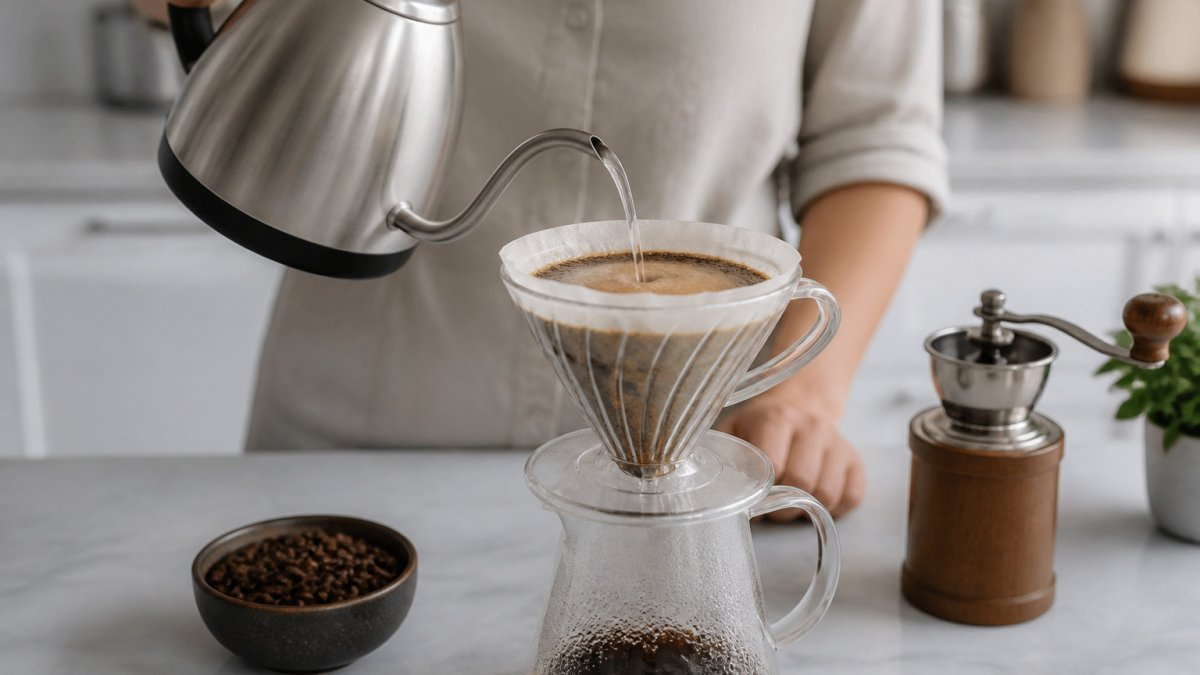
Water temperature changes how quickly the grounds release flavor. Water that is too cool pulls less out of the coffee, which can leave it sour. Water that is too hot can over-extract and taste harsh. A common target is roughly 195 to 205 degrees Fahrenheit, but if your coffee tastes sharp, try the lower end of that range. Let boiling water rest for 30 seconds before you pour, and keep your brew ratio steady so you can compare results fairly.
Step 3: Pick the Right Low-Acid Coffee Brewing Methods
Your brewing method affects how acidic the cup tastes. Cold brew steeps grounds in cool water for many hours, while French press produces a fuller-bodied cup. Brewing methods change how bright a cup tastes, so try a few to see which you prefer. For a simple, low-acid cup for one person, you can also try a French press with a coarse grind and a four-minute steep.
Watch out: Do not switch to a much finer grind and a much hotter kettle at the same time, or you can jump straight into bitterness.
Step 4: Choose Beans by Roast, Origin and Processing
Bean choice sets the floor on how sharp a cup can taste. Before you buy, separate two ideas: perceived brightness (how lively the cup reads on your tongue) and measured acidity (the actual acid content of the bean and brew). They overlap, but they are not the same. A dark roast can still taste bright if it is under-extracted, and a light roast can taste flat if it is stale. Use the framework below to pick beans that start you closer to a rounder cup, then use Steps 1-3 to finish the job.
Roast level.
Origin. Origin is a starting point, not a guarantee. Coffees from different origins vary in brightness and body, and tasting notes are the best guide to which style you prefer. Treat origin labels as a direction, then taste before you commit to a full bag.
Processing.
Freshness. Stale coffee tastes flat and can read as harsh or papery rather than sour. Check the roast date, not just the best-by date, and buy from a roaster who prints it. For guidance on how long roasted coffee keeps its flavor, read How Long Does Roasted Coffee Stay Fresh.
A practical buying sequence.
- Pick a medium or medium-dark roast.
- Choose a natural or honey process if you want more sweetness and body.
- Favor origins commonly described as rounder (Brazil, Sumatra) over brighter ones (Ethiopia, Kenya) while you troubleshoot.
- Buy a small bag first, brew it with your usual method, and taste before buying more.
- Only then adjust grind, temperature and time.
Our Brazil Santos is a medium roast with an elegant, smooth cup and cocoa notes. Our Honduras is a medium-dark roast with caramel, spice and brown sugar notes. Our Sumatra has medium acidity with a syrupy body and dark chocolate and dried fruit notes. Our Uganda offers mild acidity with a light body and floral, chocolate and dark-fruit notes.
One caveat: lower perceived acidity does not guarantee fewer stomach symptoms. If you have reflux or a sensitive stomach, treat bean choice as one variable among several and talk to a healthcare professional about your diet. The goal here is flavor, not a medical claim.

Does Salt or Baking Soda Actually Help, and What to Watch For
Some home brewers add a pinch of salt or baking soda to reduce sourness. Some people add a very small pinch of salt, and baking soda can also be tried in small amounts, though either can change the taste noticeably. Use a very small pinch at most, and taste before adding more.
For a broader look at how brewing choices affect flavor, see How to Brew French Press Coffee for One Person.
Your Next Brew: Running a Simple A/B Taste Test
The fastest way to learn what works is a side-by-side test. Brew two cups of the same coffee, changing only one variable, such as grind size or brew time. Taste them back to back and note which one is less sour. Record the grind, time and temperature in your notebook. Over a few sessions you will build a reliable routine for your favorite beans, and the sharpness you once accepted will start to feel like a problem you can solve.
Frequently Asked Questions
Does adding salt to coffee make it less acidic?
Some people add a very small pinch of salt to coffee, but it does not change the coffee's actual acidity, which is set by the beans and how they are extracted. If you try it, add only a tiny amount and taste before adding more. Too much salt makes coffee taste salty, so adjust in small steps and keep a note of what you changed.
Which coffee is the least acidic?
Coffees roasted darker and brewed with longer contact time generally taste less sharp, because roasting breaks down many of the acids that create brightness. Cold brew is also typically perceived as lower in acidity than hot-brewed coffee. Among single-origin beans, lower-acid profiles tend to show heavier body and chocolate or nutty notes rather than citrus or sharp fruit. Our Brazil Santos is a medium roast with a smooth cup and cocoa notes.
Does cold brew taste less acidic than hot coffee?
Yes, cold brew usually tastes less acidic than hot-brewed coffee made from the same beans. Cold water extracts fewer of the acidic compounds that come out quickly at higher temperatures, so the result is smoother and sweeter-tasting.
Can changing the grind size make coffee taste less sour?
Yes. Sourness can come from under-extraction, where water pulls out only some of the compounds in the grounds. Grinding slightly finer, or extending brew time, lets more of those compounds extract. If your coffee is bitter instead, go a touch coarser. Change one variable at a time and taste each result so you can see which adjustment helped.
Ready to explore beans that suit a smoother cup? Browse the Canvas and Clove LLC single origin selection and start your next brew with a coffee chosen for its balance.
